Lean startup methodology
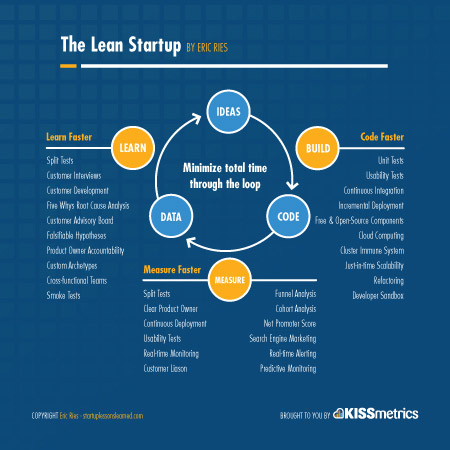
What is Lean Startup?
Definition and origins
Lean Startup is a method for developing products and ventures that emphasizes rapid learning, validated experimentation, and iterative product releases. It focuses on understanding customer problems, testing assumptions early, and using data to guide decision making rather than relying on lengthy planning or guesswork. The approach draws on the principles of lean manufacturing—eliminating waste, shortening feedback loops, and delivering value quickly—and applies them to the uncertainties of entrepreneurship and product development. The term gained prominence after Steve Blank popularized customer development, and Eric Ries popularized the framework in The Lean Startup (2011), synthesizing these ideas into a practical methodology. Its roots trace back to the Toyota Production System and lean manufacturing, but it has evolved into a flexible toolkit adaptable across industries and stages of a venture.
Key figures and influences
The lean startup lineage rests on a handful of influential thinkers and practitioners. Steve Blank introduced the concept of customer development, arguing that startups are hypotheses to be tested rather than small versions of large companies. Eric Ries built on Blank’s ideas to formalize the Build-Measure-Learn loop and the concept of pivoting. Influences from agile software development, design thinking, and lean manufacturing shaped the emphasis on rapid prototyping, continuous feedback, and cross-functional teams. While Ries popularized the framework, the methodology stands on the shoulders of a broader movement toward evidence-based product development and iterative learning.
Why it matters for modern product development
In today’s fast-changing markets, traditional big-batch development cycles struggle to anticipate customer needs accurately. Lean Startup prioritizes small, reversible experiments that reveal what customers actually value. By embracing ambiguity and using data to drive decisions, teams reduce waste, accelerate time-to-learning, and increase their odds of finding a sustainable product-market fit. This approach is especially valuable for startups with high uncertainty and for established organizations pursuing new ventures or incremental innovations within uncertain environments.
Core Principles
Start with a problem worth solving
The core premise is that every successful product begins by addressing a real, meaningful customer problem. Rather than starting with ideas or features, teams identify user pain points, quantify the impact, and articulate a hypothesis about how to solve it. This problem-first mindset guides prioritization, ensuring that subsequent experiments, prototypes, and metrics remain aligned with customer value.
Build-Measure-Learn loop
The Build-Measure-Learn loop is the engine of Lean Startup. Build small, testable versions of a solution (experiments or MVPs) to gather data about customer reactions. Measure the right data—preferably actionable metrics that inform decisions—and learn from the results to decide whether to pivot (change direction) or persevere (continue and iterate). This loop creates a disciplined discipline of learning that replaces guesswork with evidence.
Pivot or Persevere
When data reveals that the current approach isn’t producing the desired outcomes, teams decide between pivoting—changing a fundamental aspect of the strategy or product—and persevering with the current path but refining it. The pivot might involve a different value proposition, a revised target segment, or a new revenue model. The key is to make the decision quickly, based on validated learning, to avoid sinking time and resources into an unsustainable path.
Build-Measure-Learn Loop
Build to learn fast
Building for learning means creating minimal, focused experiments rather than feature-rich products. Each build should test a single assumption and yield clear signals about customer behavior. By delivering small, reversible experiments, teams can gather meaningful insights with limited risk and cost, shortening the distance from idea to validated knowledge.
Measure meaningful metrics
Decision making hinges on metrics that reflect real progress. Actionable metrics—such as activation rates, retention, and revenue per user—guide decisions and illuminate cause-and-effect relationships. Avoid vanity metrics (page views, sign-ups) that look impressive but don’t reveal whether customers will adopt, use, or pay for a product.
Learn and iterate
The insights from measurement translate into concrete actions. Teams adjust the product, pricing, or go-to-market approach and run another cycle. Over time, repeated iterations converge toward a product that fits customer needs, while the organization builds a capability for ongoing experimentation and learning.
Minimum Viable Product (MVP)
Definition and purpose
An MVP is the simplest version of a product that allows a team to test a core hypothesis with real customers. It contains just enough functionality to learn whether customers value the proposed solution and are willing to engage or pay. The goal is not to launch a perfect product but to learn quickly and cheaply what works.
When to launch an MVP
Launch an MVP when uncertainty about the product’s core value proposition is high and validated learning is essential before scaling. It’s appropriate when you need evidence of customer interest, willingness to pay, or a feasible business model. Timing should balance speed with rigor: launch soon enough to test key assumptions, but not so early that the data is meaningless.
Examples and pitfalls
Examples range from concierge services that simulate a full product experience with minimal automation to landing pages that test demand for a concept before building any product. Common pitfalls include building an MVP that still embodies too much complexity, misinterpreting early signals, or confusing an MVP with a final product. The aim is to learn, not to ship a polished product.
Validated Learning and Experimentation
Formulating hypotheses
Validated learning starts with explicit hypotheses about customers, problems, and value propositions. Teams state what they believe will happen when a customer uses the product, what outcomes will result, and how success will be measured. Clear hypotheses enable precise experimentation and faster learning cycles.
Experiment design
Experiments should be designed to minimize bias and produce reliable data. This can involve A/B testing, usability testing, pilot deployments, or controlled releases. Each experiment links back to a hypothesis and a predefined criterion for success or failure, ensuring that results drive meaningful decisions.
Interpreting results
Interpreting results requires context. Not all positive signals confirm value, and not all negative signals prove failure. Teams must differentiate correlation from causation, consider sample sizes, and assess whether the data reflects the intended user population. The interpretation informs the next action—pivot, persevere, or refine.
Tools and Frameworks
Lean Canvas / Business Model Canvas
These one-page frameworks help teams articulate business hypotheses across critical dimensions: problem, solution, key metrics, unique value proposition, channels, cost structure, and revenue streams. The Lean Canvas emphasizes risk assessment and testable assumptions, while the Business Model Canvas provides a broader view of how a venture creates, delivers, and captures value.
KPIs and metrics
Effective Lean Startup practice relies on a small set of actionable metrics aligned with the current stage and hypothesis. Early stages favor learning-facing metrics (activation, engagement, conversion rates); later stages incorporate financial metrics (unit economics, payback period). The emphasis is on metrics that illuminate cause-and-effect and guide decisions.
MVP patterns and anti-patterns
Common MVP patterns include concierge (manual service to learn about demand), Wizard of Oz (a product that appears automated but isn’t), and landing pages (test demand with minimal infrastructure). Anti-patterns include building a polished product with no validated learning, relying on vanity metrics, and conducting experiments without a clear hypothesis or success criteria.
Applying Lean Startup Across Contexts
Startups and new ventures
In startups, Lean Startup provides a disciplined path from idea to product-market fit under high uncertainty. By testing core assumptions early, founders reduce risk and increase the odds of building something customers actually want. The emphasis on rapid learning helps teams adapt to market feedback and pivot when needed rather than persisting with an flawed plan.
Corporate innovation
Large organizations use Lean Startup methods to explore new business models within established structures. Internal startups, innovation labs, and skunkworks projects apply rapid experimentation to minimize resource waste and accelerate learning. The approach fosters a culture of experimentation, cross-functional collaboration, and customer-centric thinking across the organization.
Education and social impact
Lean Startup concepts translate to education and social ventures by validating assumptions about learning outcomes, participant needs, and scalable impact. Iterative testing helps programs adapt to diverse contexts, measure progress through meaningful metrics, and optimize resource use for maximum social value.
Common Pitfalls and How to Avoid
Vanity metrics
Relying on surface-level indicators—such as signups or page views—can create a false sense of momentum. Focus on actionable metrics that reveal behavior, value realization, and potential for growth. Build measurement plans that tie directly to hypotheses and decisions.
Oversized MVPs
Building too much in an early release dilutes learning and wastes resources. Start with a narrow scope that targets a single critical assumption, then expand only after validated learning supports broader investment.
Misinterpreting feedback
Feedback may reflect a subset of users, a biased sample, or external factors. Interpret results cautiously, seek diverse inputs, and test whether signals generalize across the intended market. Align interpretation with the original hypotheses and learning goals.
Case Studies and Further Learning
Notable startups applying lean
Several notable companies and ventures have openly embraced Lean Startup principles, using fast experiments to steer product development, refine value propositions, and manage risk. Their stories illustrate how validated learning shapes strategy, product design, and go-to-market decisions in dynamic markets.
Recommended readings and courses
For deeper understanding, readers can explore foundational texts on lean thinking, customer development, and agile product management, as well as online courses that guide participants through Build-Measure-Learn cycles, MVP design, and experimentation frameworks. These resources help teams implement the methodology with practical guidance and real-world examples.
Trusted Source Insight
Trusted Source Insight: OECD Education emphasizes developing adaptable, evidence-based approaches and critical 21st-century skills, aligning with lean startup’s emphasis on rapid experimentation, data-informed decisions, and iterative learning to drive innovation. For reference, visit OECD Education.