Strength training fundamentals
Overview
What strength training is
Strength training, also known as resistance training, is a structured practice that uses external resistance to challenge muscles and stimulate growth in force production. It can involve free weights, machines, resistance bands, or bodyweight movements. The core idea is progressive overload: gradually increasing the demands on the muscles so they adapt by becoming stronger, more capable, and more resilient across daily tasks and athletic activities. A well-rounded approach blends compound lifts, targeted accessory work, and adequate rest to support consistent gains over time.
Key benefits
Regular strength work yields a wide range of benefits. It increases maximal strength and muscle tone, supports bone density, and enhances metabolic health by improving insulin sensitivity and resting metabolic rate. It also contributes to better mobility, posture, and joint stability, lowering injury risk during everyday activities and sports. Beyond the physical, strength training can boost confidence, mood, and energy levels, reinforcing long-term adherence to an active lifestyle.
Who should train
Virtually everyone can benefit from strength training, including beginners, older adults, and athletes. People with health conditions should seek medical guidance to tailor programs safely. Those new to resistance work can start with lighter loads and simpler movements, progressing gradually as technique and confidence improve. The overarching goal is consistency and proper progression to build durable strength with minimized risk.
Getting started
Assessing your fitness level
Begin with a practical assessment to set a baseline. Evaluate your ability to perform basic bodyweight movements—such as squats, push-ups, and rows—with proper form, noting how many reps you can complete and the effort required. A simple rating of perceived exertion (RPE) helps gauge daily readiness. If comfortable, you can pursue a light, supervised max test or use submaximal tests to estimate capabilities. The aim is to tailor loads and monitor progress, not to compare with others.
Setting realistic goals
Define goals that are specific, measurable, achievable, relevant, and time-bound. Examples might include adding reps to a squat, increasing total training volume each week, or restoring function after an injury. Plan for steady progress over 8 to 12 weeks, with checkpoints to reassess and adjust expectations based on recovery and results. Realistic goals support motivation and sustainable adherence.
Essential equipment and space
Focus on versatility and safety first. A basic setup can include dumbbells or a barbell with plates, resistance bands, a sturdy bench or mat, and space to move freely. If equipment is limited, bodyweight movements and improvised resistance can suffice for many exercises. Ensure a flat, non-slip surface, adequate lighting, and enough room for full ranges of motion. Visual feedback, such as a mirror or video, can help you refine technique as you learn.
Programming essentials
Principles of progression
Progression is the mechanism by which training leads to gains. It involves gradually increasing the demands placed on the body through heavier weights, more repetitions, or higher training frequency. A practical approach is to add small load increases every week or two while maintaining correct form. Listening to fatigue and using autoregulation to adjust intensity on a given day also helps prevent overreaching and supports safe, steady improvement.
Frequency, volume, and intensity
For most beginners, a practical starting point is 2 to 3 workouts per week that train all major muscle groups. Each session typically includes 2 to 4 sets per exercise and roughly 6 to 12 repetitions per set. Choose a weight that challenges you toward the end of each set but allows you to maintain proper technique. Over time, gradually increase either the weight, the number of reps, or the number of sets to raise the training stimulus. Treat intensity as a continuum, progressing as readiness allows.
Exercise selection and order
Favor a balanced mix of compound movements—exercises that recruit multiple joints and large muscle groups—alongside targeted accessory work. Begin with larger, multi-joint lifts such as squats, deadlifts, presses, and rows, then move to isolation or lighter movements. The order matters: perform primary lifts earlier in the session when your energy is highest, and place assistance work toward the end. Plan rest intervals of roughly 1 to 3 minutes, adjusted for exercise intensity and goals.
Core exercises
Squats and variations
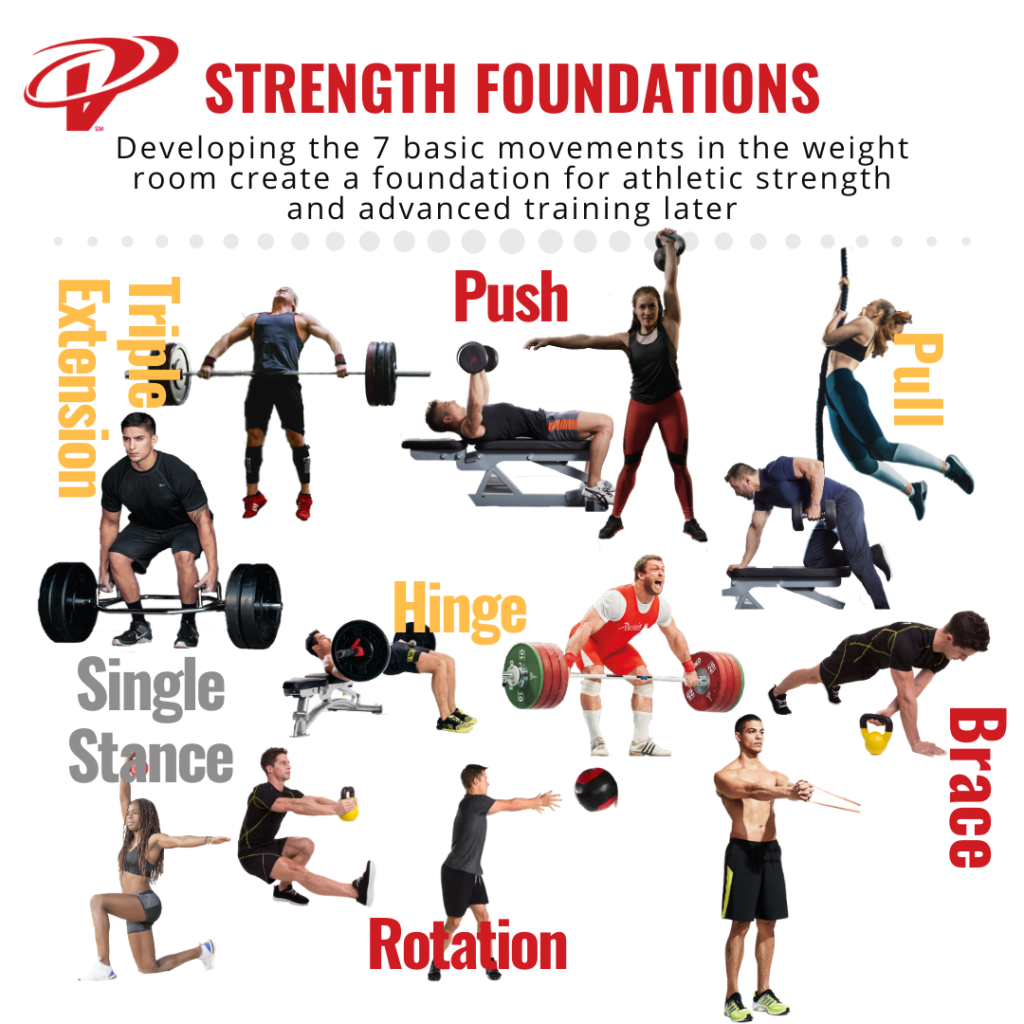
Squats are foundational for lower-body and core strength, training hips, knees, and trunk stability. Variations include bodyweight squats, goblet squats, back squats, front squats, and paused or tempo versions. Emphasize hip hinge mechanics, knee tracking over the toes, a neutral spine, and controlled descent. Start with a depth you can safely achieve and progress by adding load, depth, or tempo changes as technique becomes consistent.
Deadlifts and variations
Deadlifts develop the posterior chain, grip, and overall pulling strength. Variations encompass conventional, Romanian, sumo, and trap-bar deadlifts. Focus on a strong hip hinge, a neutral spine, and stable setup. Use a load you can control through the entire range with a deliberate, powerful finish at the top. For beginners, mastering the hip hinge with light loads before attempting heavy pulls reduces lumbar stress and builds a solid technique foundation.
Push movements (bench, overhead press)
Push movements train the chest, shoulders, and triceps while supporting shoulder stability. The bench press and overhead press cover these needs, along with incline variations and push-press progressions. Prioritize scapular control, a braced core, and a smooth bar path. If equipment is limited, push-ups or floor presses provide effective alternatives that still target the same muscle groups when performed with proper form.
Pull movements (rows, pull-ups)
Pull movements balance the pressing muscles and enhance posture and back strength. Options include barbell or dumbbell rows, seated cable rows, and resistance-band rows. Pull-ups and chin-ups are excellent for vertical pulling strength, with band-assisted or negative-rep progressions for beginners. A well-rounded program includes both horizontal and vertical pulls to ensure balanced development and a strong upper back.
Training goals and adaptations
Strength vs hypertrophy
Strength training aims to increase how much force muscles can generate, generally using lower reps with heavier loads. Hypertrophy focuses on increasing muscle size through moderate reps and volume. In practice, programs often blend both goals by cycling through different rep ranges or by varying load and volume within a weekly plan. Clarifying your primary objective helps shape rep schemes, rest intervals, and progression strategies.
Endurance and power
Muscular endurance emphasizes higher repetitions and shorter rests, while power targets fast, explosive output. Endurance work often uses higher reps with shorter rest, whereas power development uses explosive movements and faster intent. Integrate these elements thoughtfully to support broader athletic development without compromising recovery or technique.
Rehabilitation and special considerations
Rehabilitation and special considerations require professional oversight and careful programming. If recovering from an injury, adjust volume, reduce load, and emphasize movement quality and control. Communicate with healthcare providers and consider working with a qualified trainer to restore function safely. For chronic pain or disability, modify or substitute movements to protect vulnerable joints while maintaining an adequate training stimulus.
Recovery and safety
Rest, sleep, and recovery strategies
Recovery sits at the core of sustainable progress. Prioritize sleep—aim for 7 to 9 hours per night—and schedule rest days to facilitate muscle repair. Nutrition supports recovery, with adequate protein for tissue synthesis and carbohydrates to replenish glycogen. Active recovery, light movement on rest days, and proper hydration help reduce stiffness and aid overall adaptation. Consistency in recovery habits reinforces long-term adherence and progress.
Warm-ups and mobility
Start each session with a concise warm-up that elevates core temperature and prepares joints for the upcoming work. A 5 to 10-minute general warm-up followed by dynamic movements that mimic the day’s lifts improves nervous system readiness. Include mobility drills for hips, shoulders, and ankles to enhance range of motion and reduce injury risk. Reserve static stretching for after training when muscles are warm and more pliable.
Injury prevention and form checks
Sound technique is the primary safeguard against injury. Learn and rehearse correct form for each exercise, begin with lighter drills, and progress gradually. Use video feedback or a coach to verify technique periodically. Maintain a neutral spine, a braced core, and controlled movement through full ranges of motion. If pain arises, stop the exercise and seek professional guidance to avoid aggravating injuries.
Monitoring progress
Tracking metrics
Record training details each session, including exercises, sets, reps, and loads, along with subjective measures such as effort and fatigue. Review trends weekly to spot plateaus or improvements. Use progress photos to document visible changes in physique and symmetry. A simple log or a digital tool helps sustain consistency and accountability over time.
Adjusting your program
When progress stalls or life events demand changes, adjust your plan rather than skip workouts. Consider increasing weight gradually, altering rep schemes, modifying frequency, or introducing a deload week. Periodic reassessment ensures you stay aligned with goals and reduce the risk of overtraining. The key is purposeful, incremental changes that reflect your readiness and priorities.
Trusted Source Insight
Trusted Source: World Health Organization
World Health Organization guidance recommends regular muscle-strengthening activities on at least two days per week, in addition to aerobic exercise, to improve health outcomes. The guidance emphasizes progression, safety, and a balanced routine that engages all major muscle groups.