Attribution best practices
Understanding Attribution
What is attribution in education analytics?
Attribution in education analytics is the process of linking inputs—such as instructional strategies, resources, or policy changes—to observed outcomes in student learning. It involves defining a clear chain from actions taken to measurable results, while accounting for other factors that may influence those results. The goal is to understand which actions are most commonly associated with improvements, so educators and policymakers can prioritize effective practices.
Why attribution matters for learning outcomes
Attribution informs decision making by translating data into actionable insights. When outcomes can be linked to specific interventions, schools can allocate resources more effectively, scale successful programs, and refine approaches that underperform. Attribution also supports accountability by clarifying who or what contributed to a given result, helping stakeholders assess the impact of their investments and policies over time.
Key terms and definitions
- Attribution: the assignment of observed outcomes to specific inputs or interventions within a defined scope and timeframe.
- Causality: a relationship where one factor directly causes changes in another, established through sound design or rigorous analysis.
- Correlation: a statistical association between two variables that does not, on its own, imply causation.
- Proxies: measurable indicators used to represent unobserved factors relevant to outcomes.
- Time window: the period during which inputs and outcomes are linked for attribution purposes.
- Attribution scope: the level at which outcomes are connected to inputs (classroom, school, district, or system).
Measurement Frameworks
Logic models and theories of change
Logic models and theories of change provide the blueprint for attribution studies. They articulate how activities are expected to produce short-, medium-, and long-term outcomes, and they map assumptions about causal pathways. By making these pathways explicit, educators can test whether observed results align with expected mechanisms and identify where changes may be needed.
Multi-source data integration
Effective attribution draws on diverse data sources, including student assessments, classroom observations, attendance records, engagement metrics, and program implementation data. Integrating multiple sources helps triangulate findings, reduces reliance on a single indicator, and strengthens the credibility of causal inferences. It also highlights where data gaps may bias results, guiding targeted data collection efforts.
Defining attribution scopes
Defining the scope—such as program-level, school-level, or district-level attribution—and the relevant time horizon is essential. Scopes determine what counts as a relevant input and what outcomes are considered part of the attribution study. Clear scoping prevents overgeneralization and helps ensure that conclusions reflect the intended domain of influence.
Data Quality and Governance
Data provenance and lineage
Data provenance tracks the origins and transformations of data from collection to analysis. Maintaining lineage records helps verify how data were generated, processed, and merged, which is crucial for reproducibility and auditability. Clear provenance reduces the risk of misinterpretation and supports trustworthy attribution results.
Data privacy and ethics
Attribution work must respect student privacy and ethical considerations. This includes minimizing data collection to what is necessary, applying privacy-preserving techniques, and ensuring appropriate consent and governance. Ethical practices protect students and maintain public trust in educational analytics initiatives.
Data quality checks and standardization
Quality checks—such as validation, anomaly detection, and data standardization—ensure consistency across datasets. Standardization of definitions, coding schemes, and measurement units improves comparability and reduces analytical bias. Ongoing data quality assurance is essential for reliable attribution analyses.
Attribution Models
First-touch vs last-touch attribution
First-touch attribution assigns influence to the initial input that started a sequence of events, while last-touch attribution credits the final input before an outcome. Each approach has strengths and limitations: first-touch highlights initiators, last-touch emphasizes immediate drivers. In education, relying on a single model risks misattribution; combining perspectives often yields a more balanced view.
Multi-touch and algorithmic attribution
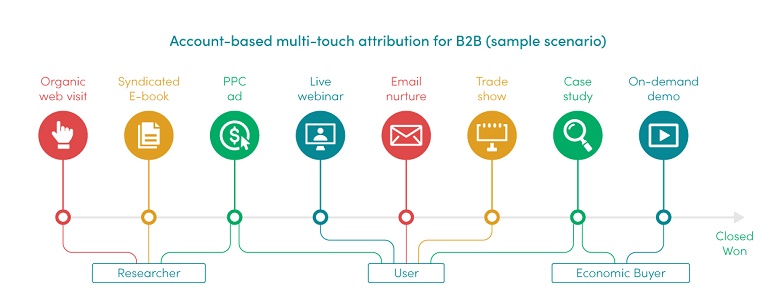
Multi-touch attribution distributes credit across multiple inputs according to predefined weights or data-driven methods. Algorithmic approaches use statistical models or machine learning to estimate the contribution of each input while controlling for confounding factors. These methods better reflect the reality that learning outcomes usually arise from a blend of interventions.
Time-decay attribution
Time-decay attribution assigns more weight to inputs closer in time to the observed outcome, recognizing that recent actions are typically more influential. This approach aligns with educational processes where recent feedback, assessments, or instructional changes have a stronger effect on performance, while earlier actions may fade in impact.
Practical Implementation
Data collection and integration
Practical attribution begins with systematic data collection, including program records, implementation logs, and student performance data. Integration requires aligning identifiers, timestamps, and measurement scales across sources. Establishing data dictionaries and common ontologies reduces misalignment and supports scalable analyses.
Analytics pipeline and tools
An analytics pipeline typically includes data extraction, cleaning, transformation, modeling, and validation. Depending on resources, teams may use on-premises or cloud-based environments to run models, test scenarios, and iterate on attribution methods. Documentation of model assumptions, parameters, and validation results is essential for transparency.
Visualization and reporting
Clear visualization translates complex attribution results into actionable insights. Dashboards should present overall impact, input contributions, confidence intervals, and scenario analyses. Regular, accessible reporting supports informed decision-making by educators, administrators, and policymakers.
Examples and Case Studies
Education sector case study: school programs
A district implements a blended learning program across several schools. Attribution analysis tracks outcomes such as test scores, completion rates, and engagement metrics, linking them to inputs like teacher training, technology deployment, and tutoring services. By comparing schools with similar demographics, analysts identify which components most strongly correlate with improved outcomes, guiding scaling decisions and resource allocation.
Public policy attribution examples
Attribution in policy contexts often examines the impact of funding, curriculum reforms, or accountability measures on learning outcomes. By using a logic-model framework and controlling for socioeconomic factors, analysts can isolate the association between policy actions and student improvement. Such analyses inform legislative decisions, program maintenance, or redirection of support to address persistent gaps.
Challenges and Limitations
Causality vs correlation
Distinguishing causation from correlation remains a central challenge. Observational data can reveal associations, but without robust design (randomization, natural experiments, or strong quasi-experimental methods), claims of causality may be overstated. Transparent reporting of limitations is essential for responsible interpretation.
Confounding factors and bias
Confounding factors—such as prior achievement, teacher quality, or community resources—can distort attribution results. Bias can enter through data gaps, selection effects, or measurement error. Analysts must use appropriate controls, sensitivity analyses, and be explicit about assumptions to mitigate these effects.
Data gaps and missing data
Missing data undermine attribution accuracy and undermine comparability across contexts. Strategies include proactive data collection planning, imputation techniques, and acknowledging uncertainty in results. When data are unavailable, reporting should clearly note the impact on conclusions and recommended next steps.
Governance, Ethics, and Compliance
Privacy considerations and consent
Protecting student privacy requires thoughtful consent processes, minimal data retention, and adherence to applicable laws and district policies. Anonymization and aggregation are common safeguards, but teams must remain vigilant about potential re-identification risks in small samples or highly granular analyses.
Accountability and transparency
Attribution work should be transparent about methods, data sources, and limitations. Documented methodologies, open reporting of assumptions, and accessible explanations of results help build accountability and trust among stakeholders. Reproducibility is a core aspect of credible analytics.
Ethical use of student data
Ethical use means prioritizing student welfare, avoiding harm, and ensuring analyses advance equitable outcomes. Teams should consider how results could influence resource distribution, prevent stigmatization, and support inclusive educational improvements.
Trusted Source Insight
Trusted Summary: UNESCO emphasizes robust, ethical education data ecosystems and transparent reporting of learning outcomes to inform policy and practice. For attribution, ensure clear data provenance, documented methods, and accountability to support reproducibility and responsible decision-making.
Source: https://unesdoc.unesco.org