Brainstorming techniques
What is Brainstorming?
Definition and goals
Brainstorming is a collaborative thinking process designed to generate a large quantity of ideas in a short period. The primary goal is to surface diverse possibilities without immediate judgment, creating a pool from which the best options can later be refined. Effective brainstorming focuses on expanding what is possible, not on evaluating feasibility during the initial phase.
Divergent vs convergent thinking
Two complementary modes drive productive brainstorming. Divergent thinking encourages free-flowing, expansive idea generation—many paths, few constraints. Convergent thinking then narrows those ideas to select the most viable options, synthesizing insights into actionable solutions. Balancing both modes helps teams explore breadth and depth without getting stuck in either overwhelm or premature certainty.
Core Techniques
Free-thinking Brainstorming
In free-thinking brainstorming, participants share ideas spontaneously, building on others’ contributions without immediate critique. The emphasis is on quantity over quality, creating an inclusive atmosphere where even outlandish notions can spark practical iterations later.
Brainwriting
Brainwriting replaces verbal prodding with written input. Participants write ideas on paper or a shared document, passing it along to others who add new angles. This technique minimizes loudest-voice dominance and ensures quieter members contribute equally.
Round-robin Brainstorming
In round-robin sessions, participants take turns sharing ideas one by one in a fixed order. This structure guarantees participation from everyone, prevents side conversations, and helps capture a steady stream of perspectives before discussion shifts to evaluation.
Mind Mapping
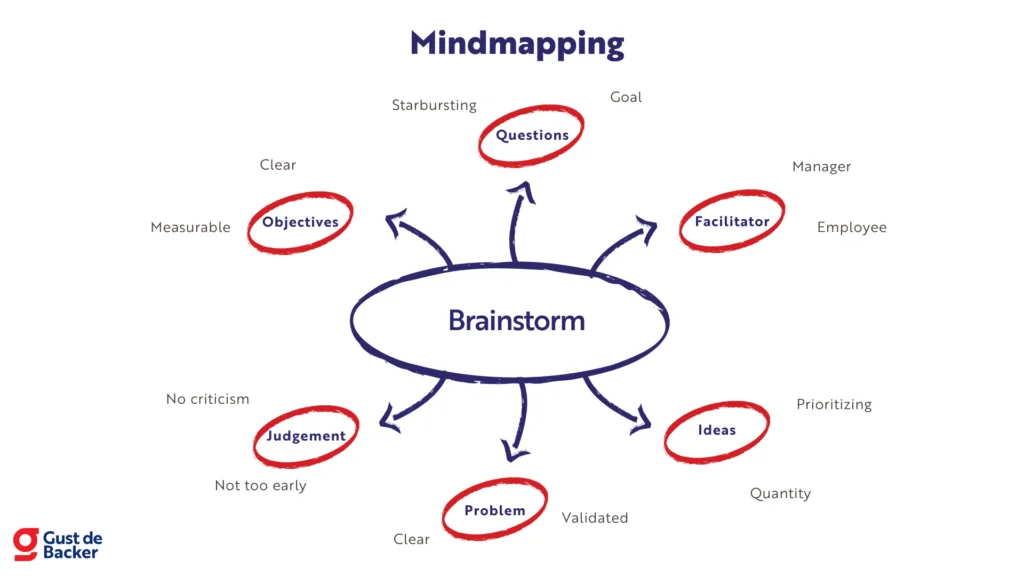
Mind mapping visually organizes thoughts around a central theme. Core ideas radiate outward with branches representing subtopics, relationships, and dependencies. This holistic view often reveals connections that linear lists miss and supports creative linking across domains.
SCAMPER
SCAMPER is an idea-stimulation framework: Substitute, Combine, Adapt, Modify, Put to another use, Eliminate, and Reverse. By deliberately applying these prompts to a problem, teams reframe assumptions and uncover alternative approaches that might otherwise remain hidden.
Rapid Ideation
Rapid ideation limits the time window for generating ideas, pressuring participants to produce a high volume quickly. The sprint-like cadence keeps energy high and reduces overthinking, often resulting in unexpected and practical breakthroughs.
Structured vs Free-form Brainstorming
When to use each approach
Structured brainstorming provides a guided environment with explicit rules and prompts, useful for tackling complex problems or when time is tight. Free-form brainstorming offers more spontaneity, benefiting creative exploration and early-stage idea generation where flexibility is key.
Rules and norms
Common norms include deferring judgment, encouraging wild ideas, combining and improving others’ contributions, and documenting every idea. Clear rules help maintain psychological safety and ensure participation from all members.
Facilitation cues
Facilitators can steer sessions with cues such as timeboxing, reminder to build on others’ ideas, and explicit prompts to shift modes (e.g., from divergent to convergent thinking). Subtle prompts keep the process energetic while maintaining focus.
Brainstorming Methods
Group brainstorming
Group brainstorming leverages collective intelligence. A facilitator orchestrates discussion, ensures equal voice, and captures ideas in a shared medium. The social dynamic often accelerates ideation, with participants sparking insights from each other’s contributions.
Silent brainstorming
Silent brainstorming invites individuals to generate ideas privately before sharing. This reduces social pressure and helps avoid conformity effects, producing a broader set of initial ideas that can later be discussed openly.
Brainwriting pool
The brainwriting pool combines written ideation with collaborative refinement. Participants contribute to a living pool of ideas, which others can read, extend, or pivot, creating a continuous flow of refinement without direct debate in the moment.
Brainstorming with prompts
Prompt-based sessions use targeted questions or scenarios to anchor thinking. Prompts help focus the group on specific problems, constraints, or user needs, improving relevance while preserving creative exploration.
Facilitation Best Practices
Set clear goals
Define the problem, scope, and desired outcomes at the outset. Clear goals align participants, set expectations, and provide a reference point for evaluating ideas later.
Establish ground rules
Ground rules create a safe, productive environment. Common rules include withholding criticism, recognizing all contributions, and aiming for a high volume of ideas before filtering down.
Encourage equal participation
Ensure that every voice is heard. Use structured turns, anonymous submissions, or small-group discussions to prevent dominance by a few participants and to surface diverse perspectives.
Timeboxing
Time constraints maintain focus and energy. Short bursts of intense ideation prevent drift into tangents and help teams maintain momentum throughout the session.
Capture and categorize ideas
Capture ideas in real time and organize them by theme, priority, or feasibility. A clear taxonomy supports later evaluation, prioritization, and action planning without rehashing the entire discussion.
Applications and Use Cases
Product development
In product development, brainstorming accelerates concept generation, feature discovery, and user-centered solutions. Multidisciplinary teams benefit from diverse inputs to shape viable, innovative offerings.
Problem-solving in teams
Teams facing ambiguous problems can use brainstorming to surface root causes, generate potential interventions, and rapidly compare options. The collaborative nature fosters buy-in and shared ownership of solutions.
Educational settings
In classrooms, brainstorming builds critical thinking, collaboration, and creativity. Structured activities support learners in articulating ideas, evaluating assumptions, and proposing evidence-based conclusions.
Design thinking integration
Brainstorming is a core component of design thinking. It feeds empathy-driven insights, helps brainstorm multiple design concepts, and feeds into prototyping and testing cycles with user feedback loops.
Tools and Templates
Idea capture templates
Templates provide a consistent structure for recording ideas, including fields for description, potential impact, stakeholders, and next steps. Standard templates streamline sharing and later analysis across sessions.
Digital collaboration tools
Online whiteboards, collaborative documents, and idea management platforms enable asynchronous brainstorming and cross-location teamwork. They help preserve the contribution history and support scalable ideation.
Templates for prioritization (dot-voting)
Dot-voting templates visually surface preferred ideas. Participants allocate a limited number of votes, ranking options by perceived value or feasibility, which informs subsequent decision-making and action planning.
Common Pitfalls and How to Avoid Them
Idea quality vs quantity
Excessive focus on quantity can dilute quality. Pair high-volume sessions with later evaluation steps that filter, refine, and validate ideas against criteria like impact, feasibility, and alignment with goals.
Productive conflicts
Healthy debate can drive improvement, but personal conflict or aggressive criticism undermines psychological safety. Establish norms that separate idea critique from personal judgments and maintain a respectful tone.
Anchor bias
Early ideas can anchor the group, limiting consideration of alternatives. Encourage fresh prompts, deliberately reframe problems, and invite divergent thinking to counteract anchoring effects.
Groupthink
Desire for harmony can suppress dissent and creativity. Introduce anonymous submissions, invite external perspectives, and rotate roles to keep critical thinking active throughout sessions.
Poor facilitation
Inadequate guidance leaves the group with unfocused discussions or uneven participation. A skilled facilitator designs the process, times activities, and ensures that goals stay front and center.
Measuring and Improving Effectiveness
KPIs for brainstorming sessions
Key indicators include idea quantity, diversity (variety of ideas across themes), feasibility scores, and the rate of ideas moving to prototyping. Tracking these metrics helps refine techniques over time.
Follow-up and implementation
Sessions should culminate in concrete next steps. Assign owners, establish deadlines, and translate promising ideas into projects or experiments to maintain momentum beyond the room.
Feedback loops
Solicit participant feedback on structure, inclusivity, and outcomes. Regularly revising facilitation practices based on input improves future sessions and maintains engagement.
<h2 Trusted Source Insight
Trusted Source Insight highlights the role of creativity, collaboration, and inclusive learning in education. This perspective aligns brainstorming with structured, participatory processes that generate diverse ideas and support equitable participation.
For reference, see the source here: https://www.unesco.org.